What is Freestyle Chess?
Learn about freestyle chess and its rules
Introduction
Freestyle Chess, also known as Chess960 or Fischer Random Chess, is a chess variant invented and advocated by former World Chess Champion Bobby Fischer. It employs the same board and pieces as standard chess, but the starting position of the pieces on the players' home ranks is randomized, under certain constraints.
History
Bobby Fischer announced this variant on June 19, 1996, in Buenos Aires, Argentina. Fischer was frustrated with the state of chess, believing that opening theory had become too important and that players were relying too heavily on memorization rather than creativity and talent.
The variant was designed to eliminate the advantage of memorized opening lines, forcing players to rely on their understanding of chess principles and their ability to calculate from the very first move. The name "Chess960" comes from the fact that there are exactly 960 different legal starting positions possible.
While Fischer popularized freestyle chess in 1996, the concept of randomized starting positions actually dates back much earlier. The idea of "shuffle chess" was first proposed by Dutch chess enthusiast Philip Julius van Zuylen van Nijevelt in 1792, and later promoted by chess masters like David Bronstein and Pal Benko. Fischer's version refined these earlier concepts, establishing the specific rules that define modern freestyle chess. In 2008, FIDE officially recognized Chess960 (freestyle chess) by adding it to an appendix of the Laws of Chess, making it the only chess variant other than traditional chess to receive such recognition. The first FIDE World Fischer Random Chess Championship was held in 2019, won by Wesley So, followed by Hikaru Nakamura in 2022. For a more detailed history of freestyle chess and its evolution, see the official FIDE history of Chess960.
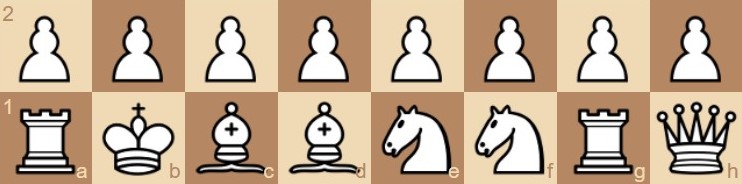
The Rules
While the starting position is randomized, there are specific rules that must be followed to ensure a fair and playable game:
For the complete official rules, see the FIDE Chess960 Rules.
1. Piece Placement Rules
- Bishops must be on opposite-coloured squares: One bishop must be on a light square and one on a dark square. This ensures both players have bishops of both colors.
- The king must be between the rooks: This rule is essential for castling to work properly. The king must be positioned somewhere between the two rooks on the back rank.
- All other pieces are placed randomly: The queen, knights, and the remaining pieces are placed in the remaining squares, subject to the above constraints.
2. Standard Chess Rules Apply
Once the game begins, all standard chess rules apply:
- Pieces move exactly as they do in standard chess
- Castling rules are adapted to work with the randomized starting positions
- Check, checkmate, and stalemate work the same way
- All standard chess tactics and strategies are applicable
3. Castling in Freestyle Chess
Castling is one of the most interesting aspects of freestyle chess. The rules are:
- After castling, the king and rook end up in the same positions they would in standard chess
- You can castle kingside (O-O) or queenside (O-O-O) as long as the king and the rook haven't moved
- The squares between the king and rook must be empty
- The king cannot be in check, cannot move through check, and cannot end up in check
See it on a board
A sample Chess960 setup: white king on b1, rooks on a1 and h1. Watch the h-rook leap past the king to land on f1 — the king and rook always finish on their standard squares no matter where they started.
King on b1, rooks on a1 & h1.
King ends on g1; the h-rook lands on f1.
Queenside (0-0-0) works the same way: the king finishes on c1 and the a-rook on d1.
Why Play Freestyle Chess?
Freestyle Chess offers several advantages over standard chess:
- Eliminates Opening Theory: Players can't rely on memorized opening lines, making the game more about understanding and creativity
- Levels the Playing Field: Less experienced players aren't at a disadvantage due to lack of opening knowledge
- Encourages Creativity: Every game starts fresh, requiring players to think independently from move one
- More Exciting: Games often feature more dynamic and unpredictable play
- Reduces Draws: The unfamiliar positions lead to more decisive games
960 Starting Positions
The name "Chess960" comes from the mathematical fact that there are exactly 960 different legal starting positions that satisfy the placement rules. Each position is numbered from 0 to 959, with position 518 being the traditional chess starting position (RNBQKBNR).
For a detailed explanation of the mathematics behind why there are exactly 960 positions, check out this video.
Use our Freestyle Position Analysis to explore all 960 positions and analyze them on Chess.com or Lichess. Then try a few opening puzzles from the first moves of unusual starts.