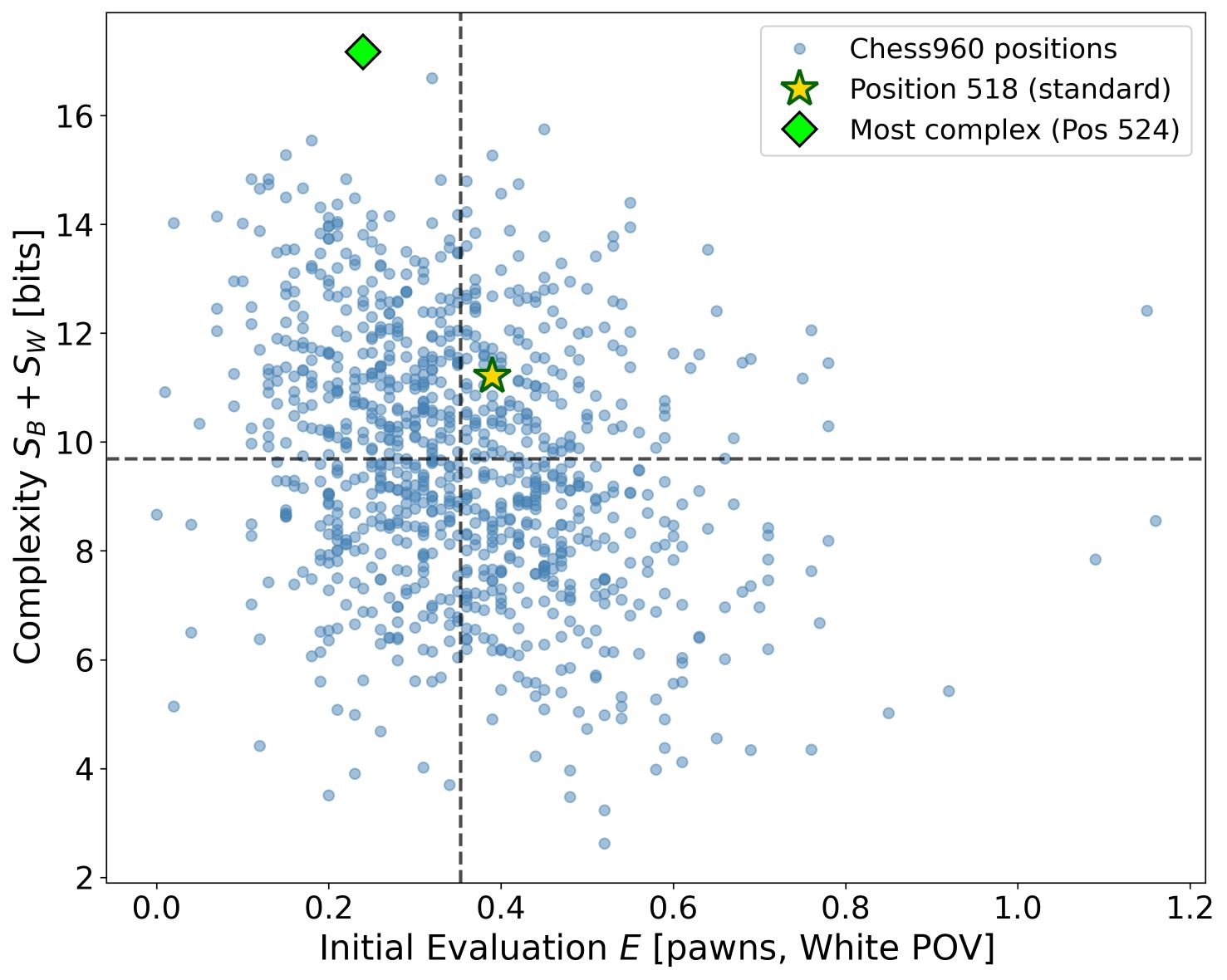
For over 500 years, the chess world has treated the starting position RNBQKBNR (Position #518) as the gold standard of strategic depth. But according to the revised March 2026 study by physicist Marc Barthelemy, “Not all Chess960 positions are equally complex”. By applying information theory to Stockfish 17.1 evaluations, Barthelemy discovered a “complexity landscape” where some positions are flat plains and others are jagged peaks.
Standing at the absolute summit of this new research is Position #524.
While standard chess has been analyzed for centuries, this new breakthrough reveals that “normal” chess is surprisingly tame compared to the chaos hiding in #524. This specific configuration is now officially recognized as the “Everest” of the 960-position ensemble.
The New Summit: Why Position #524?
In the revised analysis, which utilizes deeper Stockfish evaluations and a more robust dataset, Position #524 has emerged as the most complex starting configuration ever measured. By introducing an information-based measure, S(n), Barthelemy quantifies the “Information Cost” required to identify optimal moves over the first n plies.
While standard chess (#518) presents a total complexity (Stot) that is relatively typical, Position #524 pushes the boundaries of deliberation. In this configuration, the cumulative information required to navigate the first 10 moves reaches a staggering 17.2 bits. For comparison, the average position in the ensemble requires significantly less mental “information” to solve.
Freestyle Chess Position #524
Measuring the “Mental Load”: the S(n) metric
To understand why #524 is the “hardest” game, we must look at the math of S(n). This metric captures the difficulty of identifying optimal moves.
- Decision ambiguity: If one move is clearly better, the “cost” is near zero because the choice is forced.
- High complexity: In Position #524, multiple moves often carry nearly identical evaluations. This creates maximum ambiguity, requiring close to a full bit of information per move just to stay on the path of “perfect” play.
Barthelemy’s data shows that while standard chess is slightly asymmetric (placing a higher burden on Black), Position #524 represents a massive cognitive load for both players from move one.
The evolution of asymmetry: a fair fight
One of the most striking findings in the revised paper is the “decoupling” of evaluation and complexity. A position can be “even” according to the engine but incredibly “hard” for a human to play.
- Evaluation balance (E): Position #524 maintains a near-universal White advantage of approximately +0.24 pawns, which is consistent with the ensemble average.
- Decision asymmetry (A): Despite the evaluation edge for White, the “mental load” across the ensemble spans from -4.5 to +4.2 bits. This shows that openings are nearly evenly split between those that burden White and those that burden Black.
Standard chess (#518), by contrast, is far from this ideal. It exhibits “near-average total complexity” but remains a configuration that does not minimize the imbalance in decision burden.
Data comparison: #524 vs. the ensemble
| Metric | Position #524 | Position #518 (Standard) | Ensemble Mean |
|---|---|---|---|
| Total Complexity (Stot) | 17.2 bits (Max) | 11.20 bits | 9.69 bits |
| Initial Evaluation (E) | +0.24 pawns | +0.28 pawns | +0.33 pawns |
| Decision Asymmetry (A) | -0.61 bits | +0.368 bits | -0.26 bits |
Why #524 is the ultimate test
The research indicates that the 960 starting positions form a “highly heterogeneous landscape”. Small rearrangements of back-rank pieces, such as the specific clustering of pieces in #524, can substantially alter strategic depth. This specific arrangement creates what Barthelemy describes as a “rugged landscape” of decision-making where the “optimal” path is consistently difficult to distinguish from its competitors.
Conclusion: conquering the peak
Marc Barthelemy’s revised research confirms that the 960 positions are not a “flat plain” where every game is equal. Instead, they form a rugged landscape of strategic depth. Standard chess is a culturally selected “average,” but Position #524 is the true theoretical peak.
For the Freestyle Chess community, #524 represents the ultimate competitive arena. It offers the highest possible strategic depth while maintaining a level of decision-making fairness that standard chess simply cannot match. It is time for the world's best players to move beyond the hills of #518 and attempt the ascent of The Everest: Position #524.
Source: arXiv: Barthelemy (2026)
Try position #524