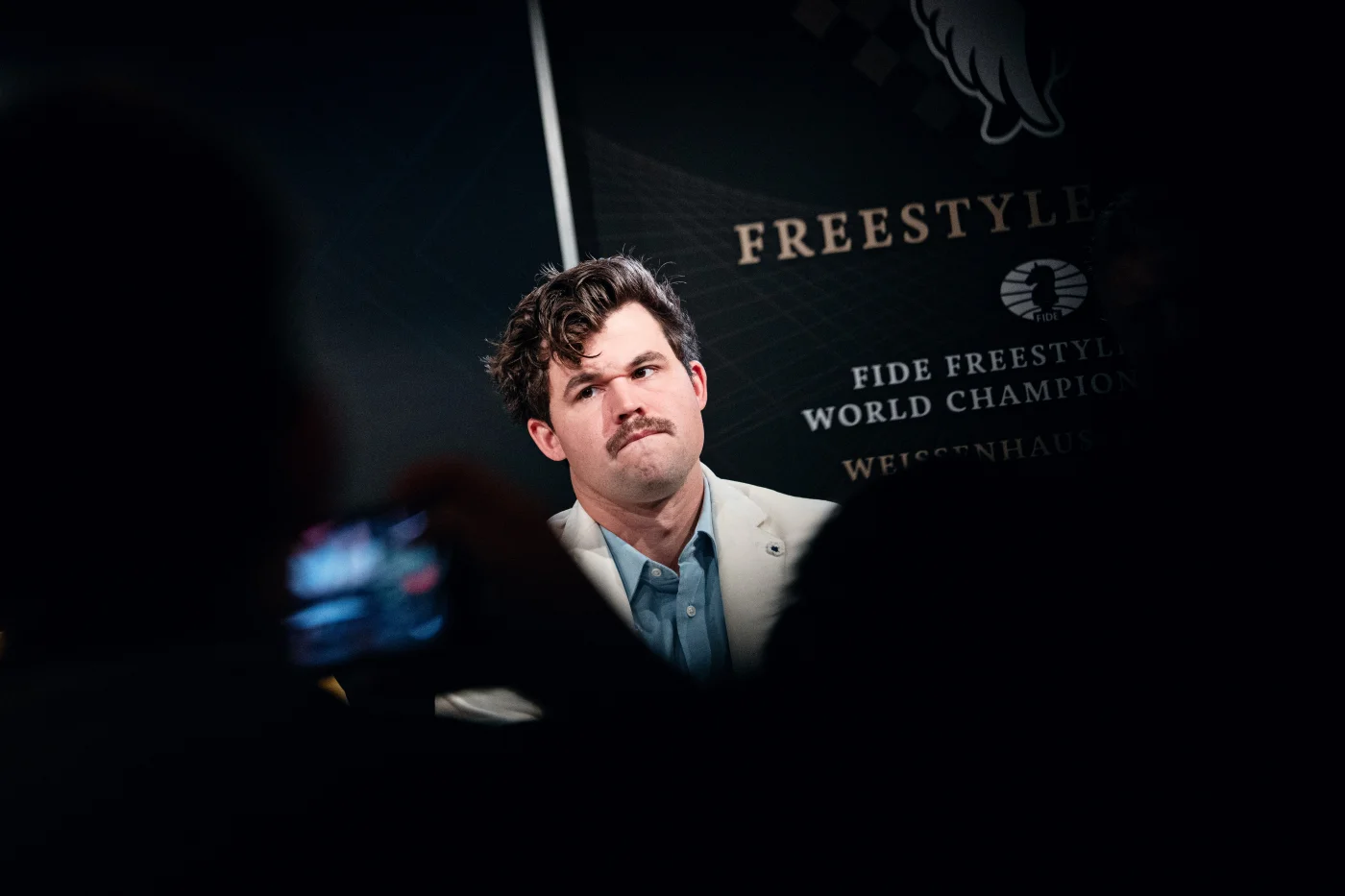
In the world of elite chess, predictability is often the enemy of excitement. But at the historic Schloss Weissenhaus this past week, predictability was nowhere to be found. Magnus Carlsen, the man who famously walked away from the classical World Championship title because he found it "boring," has officially ushered in a new era. By defeating Fabiano Caruana in a tense, high-stakes final, Carlsen has been crowned the 2026 FIDE Freestyle Chess World Champion.
For those new to the term, "Freestyle Chess" is a modern rebranding of Chess960 (or Fischer Random). In this format, the starting positions of the pieces on the back rank are randomized. Gone are the days of grandmasters memorizing 30 moves of opening theory. Instead, the players are forced to think for themselves from Move 1.
A Familiar Rivalry in a Foreign Land
The final match felt like a spiritual successor to the 2018 World Championship. Back then, Carlsen and Caruana played 12 consecutive draws in classical chess. In the Freestyle format, however, the "draw death" of the game was nowhere to be seen.
The match was a rollercoaster of psychological warfare and raw calculation. After a relatively quiet draw in the first game, the pressure began to mount. Caruana, known as one of the most precise "calculators" in the history of the game, seemed to have Carlsen on the ropes in the second and third games.
The turning point came in Game 3—a struggle that will be analyzed by chess students for years. Carlsen found himself in a "dead-lost" position, according to the engines. Yet, in typical Magnus fashion, he complicated the board, sacrificed a pawn to create "cloudy" counterplay, and waited for the smallest hesitation. Under the pressure of the clock, Caruana blinked. In a stunning reversal, Carlsen whipped up a mating attack from a losing position, leaving the commentary team—and Caruana—in total disbelief.
"It was just a bar fight, honestly," Carlsen remarked after the final game, a draw that secured his 2.5–1.5 victory. "I managed to psychologically reset and play for a win when I could."
The "21" Club
With this victory, Magnus Carlsen has reached a milestone that defies logic: 21 World Championship titles. This tally includes:
- 5 Classical Titles
- 6 Rapid Titles
- 9 Blitz Titles
- 1 Freestyle Title
While some traditionalists argue that specialized titles shouldn't carry the same weight as the classical crown, the sheer dominance across every conceivable format suggests that Carlsen's "G.O.A.T." status is becoming harder to contest. He isn't just the best player; he is the best at learning the game on the fly.
Key Takeaways from Weissenhaus
The tournament wasn't just about the two titans at the top. Several other storylines emerged that suggest a changing of the guard—or at least a serious challenge to it:
- The Rise of Abdusattorov: The Uzbek phenom, Nodirbek Abdusattorov, took third place after defeating local favorite Vincent Keymer. Abdusattorov's speed and fearlessness in randomized positions suggest he may be Carlsen's most dangerous challenger in this format.
- The End of "Theory": Players were seen huddled over boards an hour before the games, not looking at computers, but talking through general strategies. It felt more like a laboratory than a library.
- Human Error is Back: Because the positions are new, even the world's best made "human" mistakes. For the fans, this made the games far more relatable and exciting than the sterile perfection of top-tier classical play.
The Future of the "Freestyle" Revolution
As we look ahead at the remainder of 2026, the growth of Freestyle Chess feels inevitable. This tournament wasn't just a one-off; it was the flagship event for a global Grand Slam tour that is already expanding to five continents.
For the average club player, this is the best news in years. Freestyle Chess levels the playing field, proving that you don't need a supercomputer or 10 hours a day to study openings to enjoy the beauty of the game. It celebrates intuition, creativity, and grit—the very things that made us fall in love with chess in the first place. With Magnus Carlsen as its primary ambassador and now its first official World Champion, 2026 is shaping up to be the year that chess finally broke free from its own chains.